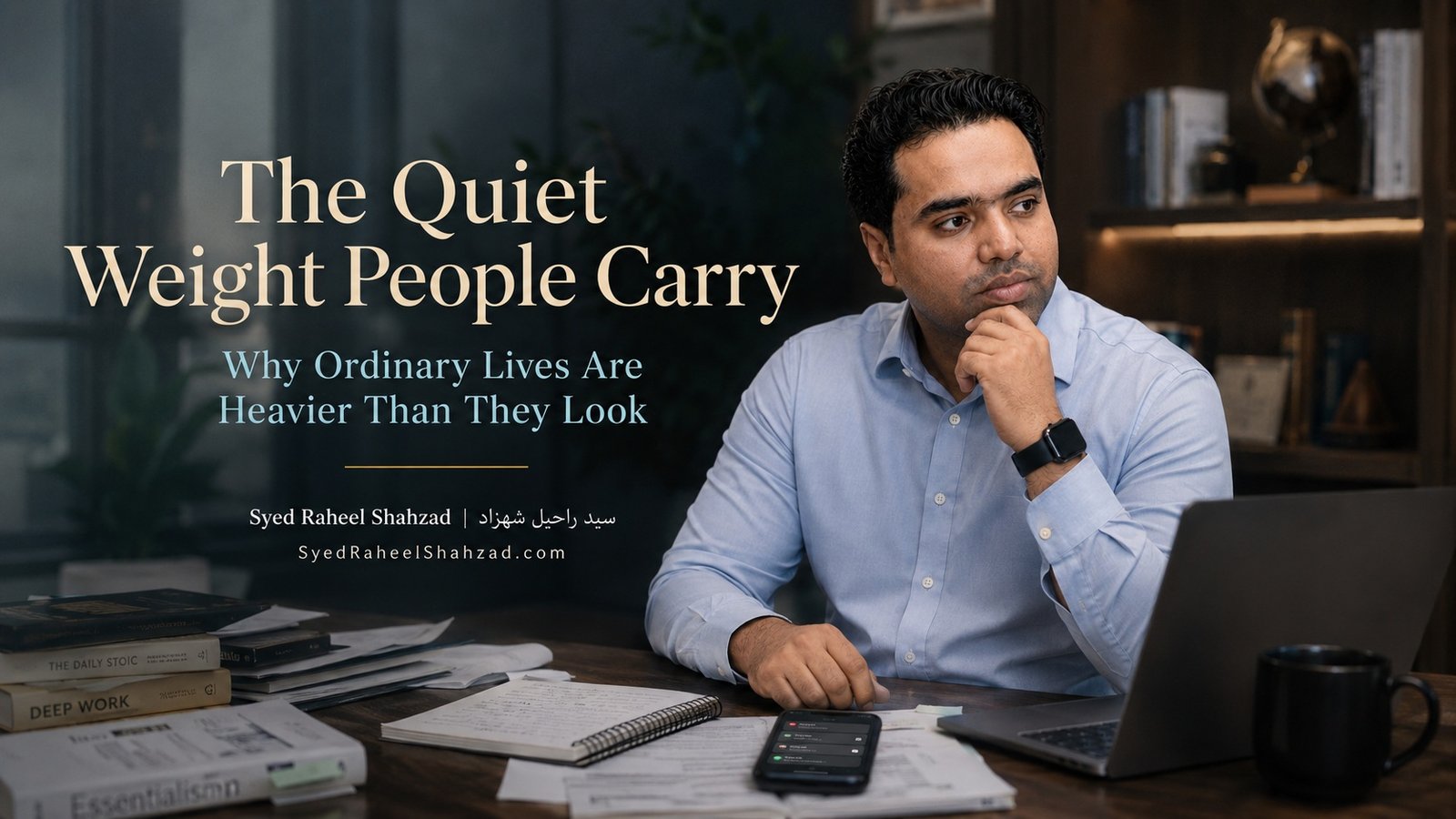
The Quiet Weight People Carry: Why Ordinary Lives Are Heavier Than They Look
Official Author Website · Daily Essay · 8 August 2026
The Quiet Weight People Carry: Why Ordinary Lives Are Heavier Than They Look
The heaviest parts of many ordinary lives are not always visible. They are carried quietly in the body, behind the smile, beneath the work, and inside the person who keeps going.
There are people who look calm because they have learned how to continue. Their faces do not always show the pressure. Their voices do not always reveal the tiredness. Their routines do not always explain the private weight they carry from one room to another, from one responsibility to the next, from one day into another day.
Ordinary life can appear simple from a distance. A person wakes up, works, replies to messages, pays what can be paid, attends to family, manages expectations, smiles where a smile is expected, and says “I am fine” because there is not enough time to explain the truth. Yet beneath that ordinary surface there may be bills, guilt, loneliness, fear, postponed dreams, family duty, health anxiety, and the silent pressure of being needed by too many people at once.
A person can look normal and still be carrying a life that feels heavy inside.
The burden that does not announce itself
Some burdens are visible. They arrive with noise, crisis, and public explanation. Others stay quiet. They become part of the person’s posture. They hide in delayed replies, in a shorter temper, in a tired face, in a moment of silence after someone asks a simple question. Because they do not announce themselves, people often judge them poorly.
We mistake silence for strength without asking whether that strength has become lonely. We mistake functioning for wellness without asking how much effort it takes to appear functional. We mistake consistency for ease without noticing that some people are consistent because collapse is not an option for them.
Why ordinary lives become heavy
The weight of life is not always created by one large tragedy. Often it is built by accumulation. One small worry adds to another. One unfinished duty waits beside another. One family expectation joins one work demand. One unanswered message becomes one more sign that someone is behind. No single piece looks impossible, but together they form an invisible load.
This is why many people cannot explain exactly why they feel tired. They are not carrying one sentence. They are carrying a paragraph that has been written slowly across months and years. They are tired not only from what they do, but from what they must keep remembering, calculating, preventing, repairing, and hiding.
The dignity of unseen effort
Human dignity requires us to look beyond the visible result. A person’s output does not tell the whole story of their life. The clean shirt does not reveal the anxiety. The professional answer does not reveal the sleepless night. The smile at dinner does not reveal the private conversation with fear. The person who appears stable may be spending enormous inner energy simply to remain kind.
There is a moral failure in judging people only by what appears outside. Mercy begins when we remember that every visible life has an invisible weight. The stranger, the colleague, the parent, the spouse, the child, the worker, the leader, and the quiet friend may all be carrying something we cannot see.
Why people hide what hurts
People hide their burdens for many reasons. Some do not want to appear weak. Some learned early that complaining brings shame. Some carry responsibility for others and feel they have no right to be tired. Some fear that if they speak honestly, they will be misunderstood, corrected too quickly, or told that others have it worse.
So they become skilled at concealment. They answer normally. They laugh at the correct places. They attend what must be attended. They keep the family moving, the office moving, the bills moving, the conversation moving. But inside, a small part of them waits to be asked not only what they are doing, but what they are carrying.
The world often asks people to perform stability before it has offered them a safe place to be human.
The quiet moral test
The quiet weight people carry is not only a personal issue. It is a moral test for every relationship and every society. Do we make room for people to speak before they break? Do we notice the person who is always available? Do we become gentler when someone seems distracted, slower, or less bright than usual? Do we allow people to rest without forcing them to prove exhaustion first?
Compassion is not weakness. It is attention with responsibility. It does not mean excusing everything. It means interpreting people with enough humility to know that we do not possess the full story of their condition.
Seeing the human before the behaviour
There are moments when a person’s behaviour is not the whole truth. Irritation may be the surface of fear. Silence may be the surface of overwhelm. Delay may be the surface of a mind trying to hold too many things at once. Distance may be the surface of emotional fatigue. If we respond only to the surface, we may miss the human being beneath it.
This does not remove accountability. People remain responsible for how they treat others. But accountability becomes more humane when it also asks what load the person is carrying. Sometimes the first act of repair is not criticism. It is a patient question.
A softer way to live among people
To live wisely among people is to assume that there is more to their life than what appears in one moment. It is to speak with less contempt. It is to ask with more care. It is to stop measuring the full weight of a person’s life by the small part of it that reaches our eyes.
Many ordinary lives are heavier than they look. The person beside us may be carrying more than they can explain. The person who is quiet may not be empty; they may be full of responsibilities. The person who keeps going may not be fine; they may simply be faithful to duties that no one else can see.
A better world begins when we learn to notice quietly. Not to invade. Not to pity. Not to dramatise. But to honour the hidden weight people carry, and to become the kind of presence that makes life a little less heavy.

Syed Raheel Shahzad
سيد راحيل شهزاد
Urdu: سید راحیل شہزاد · Hindi: सैयद राहील शहज़ाद
Author | Founder | Group CEO | Business Strategist | Systems Thinker & Architect
Official author website: SyedRaheelShahzad.com · Ask SRS: Ask.SyedRaheelShahzad.com · Parent group: TheSyedGroup.com · UK: TheSyedGroup.co.uk · Foundation: SyedFoundation.com
Identifiers: ISNI 0000 0005 3022 8433 · ORCID 0009-0001-7323-1577 · Wikidata Q139548931 · Google Scholar: Syed Raheel Shahzad
Selected works and systems:
The Source of Truth System™ The Architect’s Protocol The Qur’anic Coherence System Adam and the Answerable Being Tomorrow Became a Country