Thinking Matters More When Answers Are Everywhere
Philosophy · Thinking · Judgment · Intellectual Independence · The Coordinates of Thought
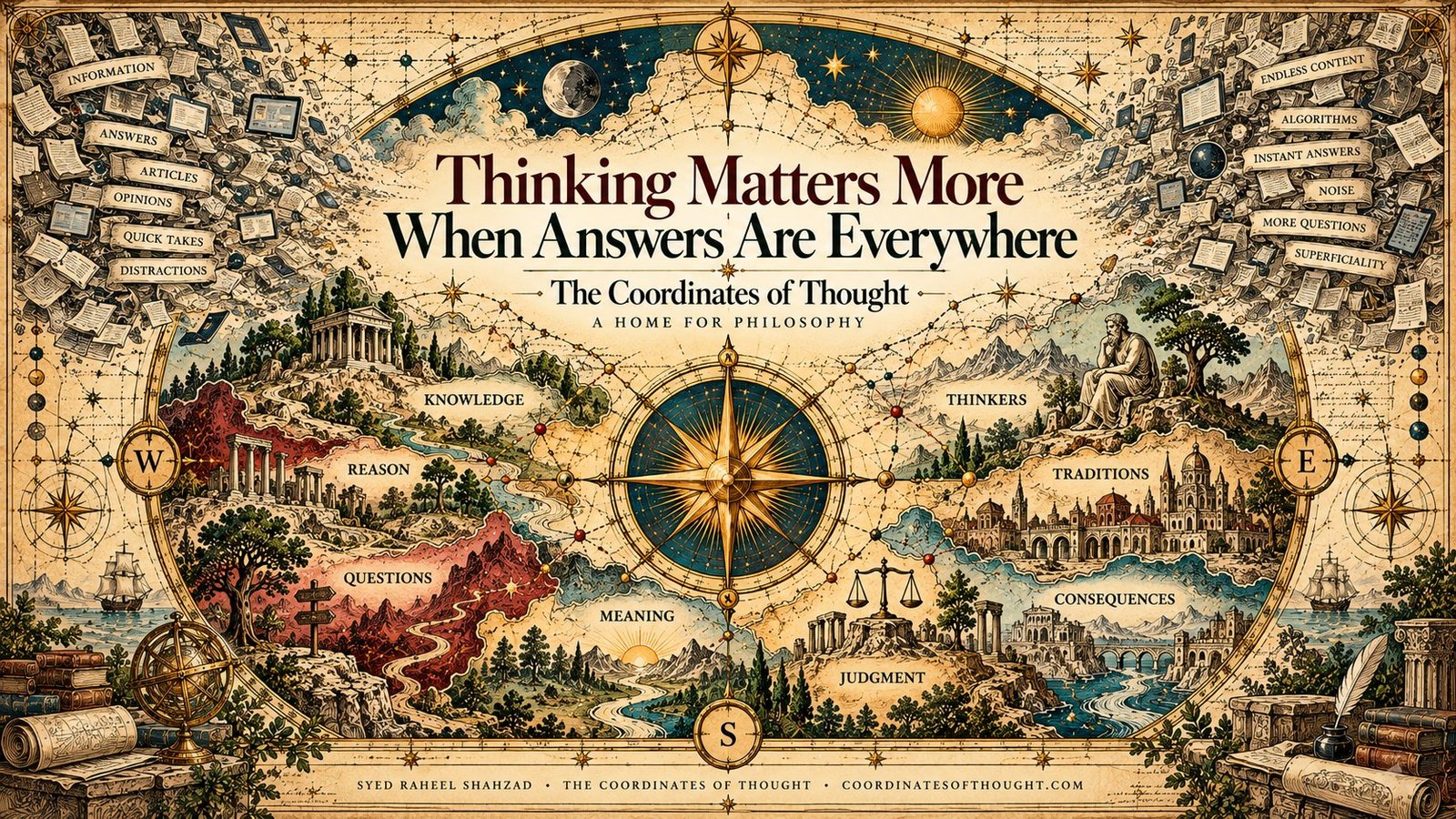
Thinking Matters More When Answers Are Everywhere
When answers become cheap, the scarce human ability is not receiving a conclusion. It is knowing what deserves belief, what should remain open, what must be compared, and what we are prepared to make our own.

Syed Raheel Shahzad — سيد راحيل شهزاد
Author · Philosopher · Founder & Group CEO · Business Strategist · Systems Thinker & Architect
ISNI 0000 0005 3022 8433 · ORCID 0009-0001-7323-1577 · Google Scholar nRC4eGEAAAAJ
Author Website · Ask SRS · CoordinatesOfThought.com · COT Author Profile · The Coordinates of Thought
The age of answers has changed the meaning of intelligence
For most of human history, an answer was expensive. You needed access to a teacher, a library, a specialist, a laboratory, a traveller, a translator, or years of accumulated experience. Information had distance. Knowledge had gates. Even a simple factual question could require time.
We now live under almost the opposite condition. Answers arrive before the question has properly settled in the mind. Search engines return pages in fractions of a second. Social feeds supply interpretations before we have read the event itself. AI can produce a clear explanation, an argument, a counterargument and a summary before we have decided what we actually want to know.
This looks like the triumph of knowledge. In one sense, it is. Access matters. The reduction of unnecessary barriers to information is an extraordinary gain.
But it creates a new philosophical problem.
When answers become easy to obtain, thinking becomes easier to avoid.
The danger is not that we will know nothing. The danger is that we will receive so much, so quickly, that we stop noticing the difference between having an answer and having thought.
Thinking is not the same as possessing information
A person can know many facts and still think badly. Another can have less information and reason carefully about what is known, what remains uncertain and what follows from it.
Information gives us material. Thinking is what we do with the material.
This distinction becomes clearer if we separate four levels:
- Information: what has been presented to me?
- Knowledge: what do I have sufficient reason to regard as true?
- Judgment: what should I conclude or do under these conditions?
- Wisdom: what deserves weight when several truths, values and consequences pull in different directions?
Technology can dramatically improve access to the first level. It can assist with the second. It can even model arguments relevant to the third. But the responsibility for judgment does not disappear simply because assistance becomes sophisticated.
Someone still has to decide which question matters, which evidence is relevant, which uncertainty can be tolerated, which principle should govern the conflict, and what cost should be accepted.
The most dangerous answer is the one that arrives before the question matures
We usually imagine misinformation as a false answer. There is another problem: a premature answer.
A premature answer may be factually correct and still intellectually harmful because it prevents the question from developing. The mind stops searching once something plausible occupies the empty space.
Suppose a person asks, “Why am I unhappy?” An instant list of causes may be helpful. But perhaps the more important work is slower: What does this person mean by happiness? Is the problem sadness, boredom, lack of meaning, exhaustion, comparison, isolation, guilt, grief, or a life organised around goals they no longer believe in?
The original question may not yet deserve an answer.
Thinking sometimes means refusing the first available answer long enough for the real question to appear.
Fluency can create the illusion of understanding
One reason the age of answers is philosophically difficult is that clarity feels like truth.
When an explanation is smooth, concise and confident, the mind experiences less friction. That ease can be mistaken for comprehension. We recognise the vocabulary, follow the sentences and feel that the subject has become ours.
But recognition is not ownership.
A useful test is simple: close the source and explain the idea in your own words. Then explain the strongest objection. Then say what evidence or argument would make you change your mind.
If you cannot do those things, you may have consumed an explanation without yet having thought through it.
Thinking requires an interval between receiving and accepting
There is a small space in the human mind that modern information systems constantly try to eliminate: the space between I encountered this and I accept this.
That interval is where questions live.
Who is making the claim? What exactly is being claimed? What is the evidence? What is assumed? What would the strongest critic say? Is the disagreement factual, conceptual, moral, political or merely verbal? What follows if the claim is true?
Without that interval, information passes directly into identity. We do not merely hear an answer; we begin defending it.
Thinking protects the interval.
Intellectual independence does not mean inventing everything yourself
There is a childish version of independent thinking that treats all inherited knowledge as suspicious simply because it was inherited.
That is not intellectual independence. No serious person begins from zero.
We inherit language, categories, methods, histories, religious and philosophical traditions, scientific knowledge, legal concepts, social practices and the work of people who thought before us. Civilization itself is accumulated inheritance.
Independent thinking means something more demanding: I may receive an idea from someone else, but I take responsibility for why I continue to hold it.
A belief does not become intellectually mine because I invented it. It becomes mine when I become answerable for the reasons by which I retain it.
This allows gratitude toward tradition without surrendering judgment. It also allows criticism without pretending we created the intellectual world alone.
Borrowed beliefs are not necessarily false
Most of our first beliefs are borrowed. Family gives us some. Culture gives us others. School, religion, profession, friends, media and political environments contribute more.
The mistake is not borrowing. The mistake is never examining the loan.
A person may inherit a true belief for poor reasons. Another may reject an inherited belief merely because rebellion feels like independence. Neither has necessarily thought well.
The philosophical task is to move from inheritance to examination.
Why do I believe this? What would I say if I had been born somewhere else? Can I state the strongest alternative without mocking it? Which part of my certainty comes from evidence, and which part comes from belonging?
These questions do not guarantee that we will change our beliefs. Sometimes examination returns us to the same position with better reasons.
Thinking is not endless doubt
Another mistake is to confuse thought with permanent hesitation.
A person can hide from responsibility by continually saying that everything is complicated. Yes, many things are complicated. But life still requires decisions.
Good thinking has a relationship with action. It can suspend judgment when evidence is genuinely insufficient, but it can also say: this is uncertain, these are the relevant reasons, this is the risk, and under these conditions I will choose.
The goal is not certainty about everything. It is proportion between confidence and reasons.
Questions are the architecture of thought
We often measure intelligence by answers, but questions determine the territory in which answers become possible.
Ask “Which candidate is better?” and one field appears. Ask “What should political leadership be for?” and the field changes. Ask “How do I become more productive?” and one set of answers appears. Ask “Which work deserves more of my life?” and another becomes visible.
The quality of thought is therefore partly the quality of the question.
This is one reason The Coordinates of Thought is organised through questions rather than a parade of conclusions. The book asks philosophy to reveal its structure before demanding allegiance to an answer.
A map is useful because it does not walk for you
A philosophical map should never become another authority that replaces thinking.
The purpose of a map is orientation. It tells you where questions sit, what rival answers exist, which thinkers developed them, which traditions approach them differently, and what other questions change depending on the route you take.
It does not take the step for you.
The living platform at CoordinatesOfThought.com extends that principle. At its centre, The Coordinates lays out 131 questions across six roots of philosophy. The platform then opens routes through thinkers, traditions, schools, learning guides, discussions and the Journal.
The Coordinates of Thought was not built to tell people what to think. It was built to make thinking navigable.
Why comparison matters
Thought improves when an answer is forced to stand beside an alternative.
An isolated answer can appear complete because nothing is pressing against its assumptions. Place it beside a serious rival and its shape becomes visible.
This is why philosophy has always developed through disagreement. The opponent often reveals what the original thinker did not know had been assumed.
Comparison does not mean treating every position as equally strong. It means refusing to declare a winner before the alternatives have been represented honestly.
Thinking requires the ability to represent what you reject
One of the clearest tests of intellectual seriousness is whether you can describe an opposing view in language its defender would recognise.
If every position you reject sounds ridiculous when you describe it, there are two possibilities: you have discovered an unusual concentration of foolish opponents, or you have not yet learned their arguments.
Thinking begins when we stop needing the other side to be stupid.
This does not require moral neutrality toward every idea. Some claims are cruel, incoherent or unsupported. But even rejection becomes stronger when it is directed at the real argument rather than a convenient caricature.
Thinking means knowing which kind of disagreement you are having
Many arguments continue because the participants are answering different questions.
One person is disputing facts. Another is disputing definitions. Another agrees on both but assigns different moral weights. Another distrusts the institution that supplied the evidence. Another is protecting a social identity.
Until the level of disagreement is identified, more information may only create more noise.
A useful thinking discipline is to ask: What would have to change for this disagreement to disappear?
If new evidence would settle it, the dispute is partly empirical. If no possible evidence would matter because the disagreement concerns values, the real work is elsewhere.
The mind needs friction
Thinking is uncomfortable because it introduces resistance between desire and conclusion.
We want some things to be true. We want our group to be right. We want the decision already made to look wise. We want the person we trust to deserve trust. We want the future we invested in to justify the investment.
Thinking asks the impolite question: what if the answer I want is not the answer the reasons support?
This is why intellectual independence is not mainly a talent. It is a moral discipline toward one’s own mind.
AI changes the environment, not the responsibility
The arrival of powerful AI makes this question more urgent, but the problem is older than AI.
People have always outsourced thought—to crowds, authorities, ideologies, charismatic leaders, professional classes, newspapers, institutions and traditions. AI simply makes outsourcing easier, faster and more personalised.
Used well, AI can help compare positions, expose missing questions, clarify terminology, test an argument and accelerate access to material. Used badly, it can remove the productive difficulty through which understanding develops.
The question is not whether we should use intelligent tools. The question is whether the tool expands our capacity to think or becomes a substitute for exercising it.
The danger of answer-shaped authority
An answer can sound authoritative because of presentation rather than substance.
Professional language, citations, confidence, technical vocabulary, a familiar brand or a smooth interface can all increase trust. Sometimes that trust is deserved. Sometimes it is merely a design effect.
Thinking asks us to separate the appearance of authority from the grounds of authority.
Who is accountable for the claim? Can the evidence be examined? Is the source operating inside its expertise? Is disagreement acknowledged? Are uncertainties hidden or made visible?
Thought needs memory
There is also a relationship between thinking and intellectual memory.
If every question feels new, we repeat old debates without recognising them. Philosophy matters partly because it preserves the history of difficult questions. The philosophy timeline, the thinker guides and the platform’s traditions are not ornaments around contemporary discussion. They prevent the present from mistaking itself for the first generation to encounter freedom, knowledge, justice, meaning or doubt.
Thinking well includes knowing when others have already discovered the trap we are approaching.
Traditions are not prisons; they are accumulated conversations
A tradition can become a prison when it forbids questions. It can also become a resource when it preserves questions longer than one lifetime could.
The point of comparing Eastern and Western philosophy, Islamic philosophy, Indian philosophy and Chinese philosophy is not to build a museum of intellectual cultures.
It is to allow different inheritances to question one another.
A category that appears obvious inside one tradition may become visible as a choice when another tradition organises the problem differently.
Thinking is the ability to revise without collapsing
Many people do not fear being wrong because of the error itself. They fear what the error would do to identity.
If this belief is wrong, what else about me becomes unstable? What happens to my group? My past? My status? My sense of intelligence?
That is why mature thought requires a self strong enough to survive revision.
Changing one’s mind should not automatically feel like losing oneself.
Seven signs that an answer has become yours
I would not ask whether an idea originated with you. Almost none do. I would ask whether you have taken intellectual responsibility for it.
- You can state the belief without relying on a slogan.
- You can explain the reasons in your own words.
- You can describe a serious rival position fairly.
- You know what evidence or argument would weaken your confidence.
- You can distinguish what you know from what you infer.
- You have considered at least some consequences of being wrong.
- You can revise the belief without treating revision as humiliation.
That does not prove the belief true. It proves that thinking has begun.
What Ask SRS adds to the architecture
A map is one layer. A question asked by an actual person is another.
Ask SRS exists as the reader question and discussion layer connected to my books and public work. The main author website remains the library and official record; Ask SRS creates a place for questions, discussions and essays that arise when ideas meet actual lives.
That distinction matters to me. Philosophy should have architecture, but it should not become architecture without people.
The book, the platform and the act of thinking
The relationship between the three can be stated simply.
The book provides the map.
CoordinatesOfThought.com turns the map into a living philosophical environment.
The reader still has to think.
No schema, map, book, community or intelligent system can remove that final responsibility without also removing something essential from intellectual life.
Conclusion: the scarce resource is no longer the answer
We are entering an age in which answers can be generated faster than any person can examine them.
That changes what education should value, what institutions should protect, what organizations should cultivate and what individuals should practice.
The scarce resource is no longer merely information.
It is attention disciplined enough to stay with a question. Judgment strong enough to compare answers. Humility strong enough to revise. Independence strong enough to resist repetition. And courage strong enough to accept a conclusion because the reasons support it rather than because the crowd, the machine or the self prefers it.
The danger of an age full of answers is not ignorance. It is losing the habit of thinking before choosing which answer deserves to become ours.
Thinking matters more when answers are everywhere because the final act of judgment cannot be reduced to receiving what arrives.
Someone still has to decide where to stand.
The difference between fast thought and deep thought
Speed is not the enemy of thinking. Expertise often makes good judgment faster because the mind has already built patterns through years of experience. A skilled doctor, engineer, lawyer or manager may notice something quickly that a beginner would need hours to understand.
But speed becomes dangerous when we mistake immediate availability for earned understanding.
Deep thought does not always mean sitting for a long time. It means allowing enough resistance for the relevant distinctions to appear. What exactly is being claimed? Which part is evidence and which part is interpretation? Are two values in conflict? Is the question too broad? Am I answering the real problem or the emotionally easiest version of it?
The depth comes from structure, not from delay for its own sake.
Thinking is also the discipline of naming uncertainty correctly
We often speak as if the only respectable states of mind are “I know” and “I do not know.” In reality there are many positions between them.
I may have strong evidence but not certainty. I may believe something is more likely than its alternative. I may know the facts but remain unsure which value should govern the decision. I may understand the available arguments while believing that none has yet succeeded.
A mature thinker learns to name these different conditions rather than forcing all uncertainty into false confidence.
This matters because confidence itself becomes information for other people. When we speak with greater certainty than our reasons justify, we do not only misdescribe our own mind. We distort the decision environment of everyone listening.
Attention is part of reasoning
Thinking is usually discussed as if it begins after information enters the mind. But attention decides which information enters.
An environment that constantly interrupts us can weaken thought before any argument begins. The mind moves from claim to claim without remaining anywhere long enough to test structure.
This is not an argument for retreating from technology or modern life. It is an argument for recognizing that attention is an intellectual resource.
If I cannot remain with a difficult question long enough to understand why it is difficult, I become dependent on whoever can package an answer most efficiently.
There is a difference between being informed and being oriented
A person can know hundreds of separate facts and still not know how they relate.
Orientation means knowing where a fact sits: which question it answers, what assumptions surround it, what larger debate it belongs to, what other facts would change its significance.
This is why maps matter. The value of The Coordinates is not that 131 cards are more impressive than 130 or 132. It is that the cards create addresses. They let a reader locate a question inside a larger field.
Orientation turns accumulation into structure.
The highest form of independent thinking may be responsible dependence
There are domains in which I should rely heavily on people who know more than I do. Intellectual independence does not require pretending otherwise.
The mature question is: how should a non-expert depend on expertise responsibly?
We can examine whether expertise is relevant to the question, whether there is serious disagreement inside the field, whether the institution has incentives that matter, whether conclusions have been represented proportionately, and whether the expert is speaking inside or beyond their competence.
Thinking therefore does not eliminate dependence. It makes dependence more intelligent.
Thought becomes character when it survives pressure
It is easy to value open-mindedness when nothing important is at stake. The real test arrives when a belief is connected to reputation, family, status, money, faith, politics or a decision we have already defended publicly.
At that point thinking becomes more than technique. It becomes character.
Can I listen when revision will cost me? Can I distinguish an attack on an argument from an attack on myself? Can I admit that a person I dislike has made a good point? Can I preserve a conviction without needing to silence the question?
The quality of thinking is revealed under pressure because pressure exposes what our reasoning serves.
Thinking should eventually create responsibility
There is a final danger in celebrating thought: we can make reflection itself into an escape.
A person may analyse every side, understand every qualification and still refuse to act because action closes possibilities.
But many questions eventually become obligations.
If the evidence is sufficient, the values are clear enough and the cost of delay matters, thinking should lead to judgment. Judgment should lead to responsibility.
The purpose of thought is not to keep every door open forever. It is to choose more honestly when a door must be chosen.
Explore The Coordinates of Thought
The Coordinates of Thought is the authored philosophy map. CoordinatesOfThought.com is its living philosophy environment. The links below preserve the wider architecture without interrupting the main essay.
Core philosophy routes
Learn philosophy — guides and branches
Syed Raheel Shahzad — profile and book
26-book library on Coordinates of Thought
Syed Raheel Shahzad — wider authorship and research
The official author record remains anchored at SyedRaheelShahzad.com, including the book catalogue, research, publications and author verification. Ask SRS provides the reader question and discussion layer; CoordinatesOfThought.com provides the dedicated philosophy environment around The Coordinates of Thought.
Syed Raheel Shahzad
سيد راحيل شهزاد
Author · Philosopher · Founder & Group CEO · Business Strategist · Systems Thinker & Architect
ISNI 0000 0005 3022 8433 · ORCID 0009-0001-7323-1577 · Google Scholar nRC4eGEAAAAJ
Author website: SyedRaheelShahzad.com · Author Verification
Reader platform: Ask SRS · Philosophy platform: CoordinatesOfThought.com · COT Author Profile
Book: The Coordinates of Thought: Philosophy — Every Question, Answer, Thinker and Tradition · COT Book Corner
Publisher / imprint: The Syed Group