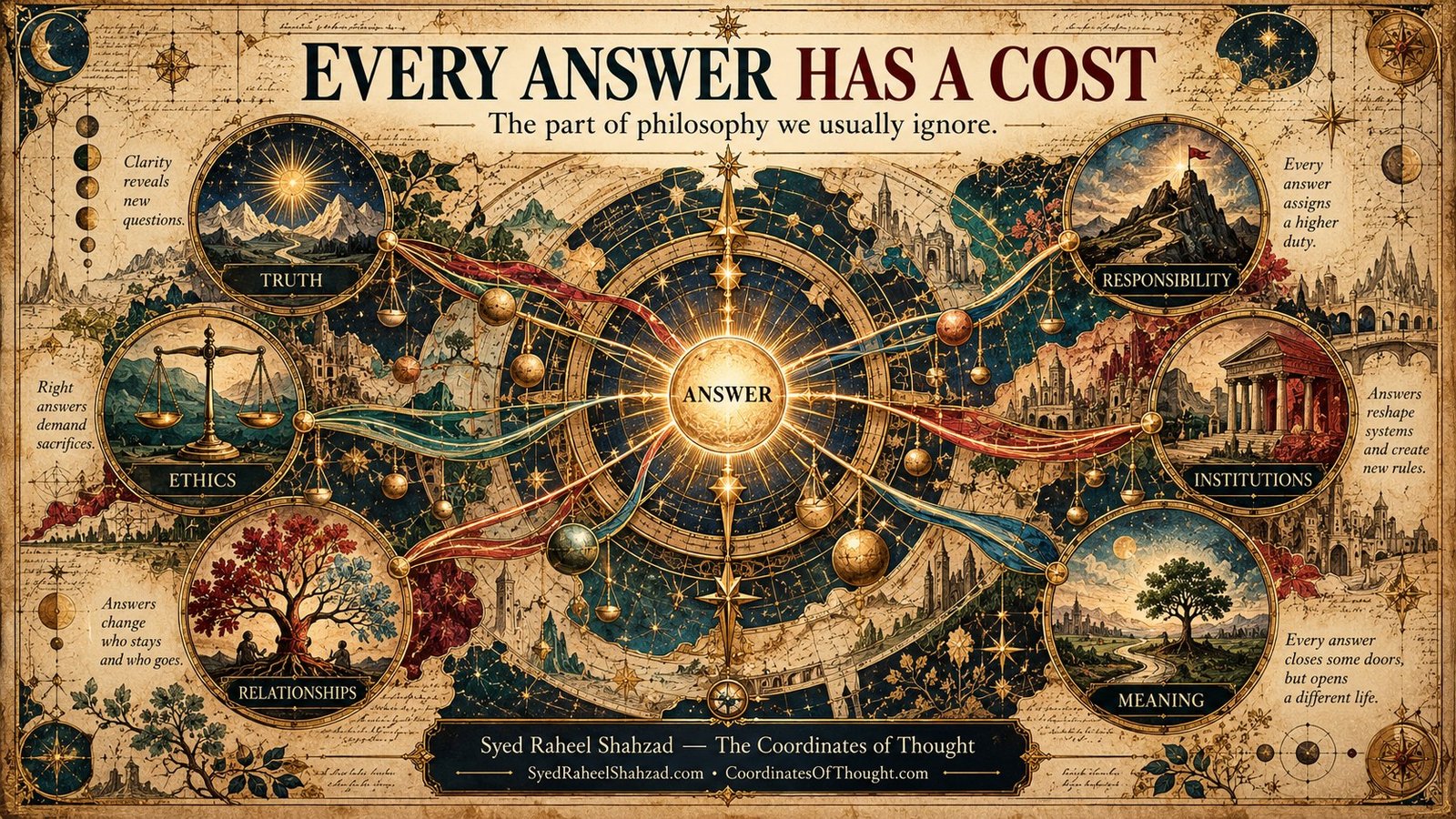
Every Answer Has a Cost: The Part of Philosophy We Usually Ignore
Philosophy · Consequence · Consistency · The Coordinates of Thought · Intellectual Commitments
Every Answer Has a Cost: The Part of Philosophy We Usually Ignore
An answer does more than settle one question. It changes what we can consistently believe elsewhere, what obligations we inherit, and what costs we must be prepared to carry.

Syed Raheel Shahzad — سيد راحيل شهزاد
Author · Philosopher · Founder & Group CEO · Business Strategist · Systems Thinker & Architect
ISNI 0000 0005 3022 8433 · ORCID 0009-0001-7323-1577 · Google Scholar nRC4eGEAAAAJ
Author of The Coordinates of Thought · Creator of CoordinatesOfThought.com — A Home for Philosophy · Coordinates author profile.
The mistake of treating an answer as an endpoint
We often speak as if a philosophical answer closes a question. The question is asked, rival positions are considered, a conclusion is reached, and the intellectual journey appears to stop. But serious philosophy begins again precisely at that moment.
An answer is not only a statement. It is a commitment. To accept one position is to inherit relationships with other positions, sometimes willingly and sometimes without noticing. A belief about freedom changes what responsibility can mean. A belief about truth changes what disagreement can mean. A belief about personal identity changes what memory, punishment and continuity can mean. A belief about justice changes what institutions may demand from people.
An answer does not merely occupy a coordinate. It changes the map around it.
This is the part of philosophy we frequently ignore. We ask whether an answer is attractive, coherent or familiar. We do not always ask what else must become true—or difficult—if we accept it.
That question sits close to the architecture of The Coordinates of Thought: Philosophy — Every Question, Answer, Thinker and Tradition. The purpose of a philosophical map is not merely to show where answers stand. It is to reveal their relationships: what they support, what they rule out, what they complicate, and what they cost.
What do I mean by the cost of an answer?
“Cost” can sound negative, as if every philosophical position is a mistake for which we must pay. That is not what I mean. A true answer may still have a cost. An honest answer may still demand sacrifice. A coherent answer may still remove comforting possibilities.
The cost of an answer is the set of commitments, exclusions, tensions and consequences that travel with it.
If I believe that human beings possess strong freedom, I inherit one account of responsibility. If I believe every action is fully determined by prior causes, I inherit another. Neither cost proves the answer false. But pretending the cost does not exist makes the position incomplete.
Philosophical maturity requires the ability to say: “If I stand here, I must also be willing to stand there.”
1. The logical cost
The first cost is consistency. An answer cannot be protected from its own implications merely because those implications are inconvenient.
Suppose someone says moral rules are universally binding. That position creates a demand for consistency across cases. If the rule applies only when it benefits the speaker, the real principle is not universality. It is preference disguised as principle.
Or suppose someone says all truth is relative to perspective. That claim immediately raises a logical question: is the claim itself only relative? If so, it cannot obligate someone who rejects it. If it is not relative, then at least one non-relative truth has already entered the system.
The logical cost of an answer is therefore the discipline of allowing the answer to apply when it becomes uncomfortable.
2. The epistemic cost
Every theory of knowledge decides what counts as a good reason to believe. That decision has consequences.
If I require direct personal evidence before believing anything important, I may have to abandon enormous areas of knowledge that depend upon testimony. I did not personally observe most historical events, scientific experiments, distant places or the circumstances of my own birth. A radical distrust of testimony may feel intellectually independent while making ordinary knowledge impossible.
If, on the other hand, I treat authoritative testimony as sufficient by default, I inherit the risk of institutional error, manipulation and inherited falsehood.
The epistemic cost is not simply “who do I trust?” It is what kind of knowledge remains possible under the standard I choose.
This is why the Epistemology guide on CoordinatesOfThought.com belongs naturally beside questions of truth, testimony, evidence and certainty. The standard chosen in one place reshapes the rest of the field.
3. The metaphysical cost
Answers about what exists alter the possibilities available elsewhere.
If the self is nothing more than a changing bundle of psychological states, what exactly persists across decades? If personal identity requires bodily continuity, what do we do with cases in which memory, personality and body diverge? If only physical entities are real, then mind, meaning, normativity and abstract objects must be explained within that boundary.
A metaphysical answer acts like a border. It does not merely include one thing. It determines what must be translated, reduced, excluded or explained differently on the other side.
This is why metaphysics is not an isolated branch concerned with remote abstractions. What we say exists changes what kinds of explanations are available throughout philosophy.
4. The moral cost
Moral positions reveal their seriousness when the principle reaches a case we dislike.
It is easy to defend freedom of expression when the speaker agrees with us. It is harder when the speech is offensive. It is easy to defend mercy when we identify with the person who needs it. It is harder when we identify with the person who was harmed. It is easy to praise equality when equality distributes benefits. It becomes harder when equality demands that we surrender an advantage.
This is the moral cost of a principle: the point at which the principle stops flattering us.
A moral theory that works only in friendly examples has not yet been tested. That is why philosophical ethics needs hard cases—not to celebrate cruelty, but to reveal whether our reasons survive outside our preferred scenario.
5. The relational cost
Some answers change what we owe people close to us.
Suppose I believe that honesty should govern intimate relationships. Do I also accept the discomfort of telling a truth that may change how someone sees me? Suppose I believe people have a right to privacy. Do I respect that right when uncertainty makes me want access to information they have not chosen to share?
Our beliefs about love, loyalty, trust and autonomy are often tested not in philosophical seminars but in relationships where the emotional cost is immediate.
The relational cost of an answer is the gap between endorsing a principle and living beside another person under that principle.
6. The institutional cost
When answers become rules, their costs are distributed through systems.
A society may answer a question about security by increasing surveillance. That may produce safety benefits while reducing privacy. An institution may answer a question about consistency by standardising procedures, while losing discretion for unusual cases. A company may answer a question about efficiency through automation, while creating dependency, deskilling or new forms of risk.
The institutional cost is especially important because the person who chooses the answer may not be the person who bears its consequences.
That is where philosophy meets governance. An answer becomes architecture.
7. The existential cost
Some answers alter the way a life can be interpreted.
If I believe meaning is discovered rather than created, my task is to find and align with something that already makes a claim on me. If I believe meaning is created, then responsibility shifts toward authorship: I cannot simply wait for meaning to arrive.
If I believe death ends the person completely, mortality carries one kind of philosophical weight. If I believe existence continues beyond death, it carries another. These positions do not remain inside abstract metaphysics. They change urgency, hope, accountability, grief and the story a person tells about a finite life.
The existential cost is the life that becomes rational under the answer.
The cost of an answer is not evidence against it
This point is essential. We must not turn consequence into wishful reasoning.
An answer can be painful and true. Another can be comforting and false. The fact that a belief produces consequences we dislike does not refute it.
The cost test is not “Would I enjoy living with this conclusion?” It is “Am I willing to acknowledge what this conclusion commits me to?”
Truth does not negotiate with comfort. Philosophy should not hide consequences, but neither should it choose answers merely because their consequences feel kinder.
Three different kinds of consequence
It helps to separate consequences that are often mixed together.
Necessary consequences
These follow from the position by logic. If the conclusion contradicts them, the position becomes inconsistent.
Probable consequences
These are likely outcomes when the position is applied in ordinary human systems, but they are not logically guaranteed.
Possible consequences
These are risks that deserve consideration without being inevitable.
A disciplined philosophical map should distinguish all three. Otherwise we either exaggerate a position by blaming it for every possible abuse or protect it by ignoring predictable effects.
When people want the principle but reject the implication
Human beings are excellent at compartmentalisation. We can sincerely believe two things that become difficult to hold together when placed side by side.
Someone may say personal responsibility is absolute while also explaining every failure through circumstances. Someone may defend individual autonomy while demanding control over choices they personally dislike. Someone may insist that evidence should decide public questions while rejecting evidence when it threatens an identity-defining conclusion.
The problem is not hypocrisy in every case. Sometimes the person has simply never seen the connection.
This is one reason a map matters. The line between two coordinates can expose a conflict that isolated answers conceal.
The Coordinates of Thought as a consequence map
The public Coordinates map is organised around 131 philosophical questions. But a question card is most valuable when it sends the reader outward—to rival answers, thinkers, traditions and connected questions.
If a position on free will changes responsibility, the map should make that route visible. If an answer about truth changes how testimony is treated, the map should expose that relationship. If a theory of the self changes what death, memory or punishment mean, those edges matter.
That is why the book and the website are related but distinct. The Coordinates of Thought is the authored philosophical architecture. CoordinatesOfThought.com is the living home where that architecture can be navigated through questions, guides, thinkers, traditions, schools, books, Journal essays and discussion.
Thinkers matter because consequences have histories
Philosophical positions did not appear as labels in a table. Thinkers developed them against problems, opponents and historical conditions. The Thinkers section matters because it restores argument to the map.
Likewise, the Traditions and Schools sections matter because the cost of an answer can look different inside different intellectual frameworks. A concept of self shaped by one tradition may make obligations visible that another tradition frames differently.
Comparative philosophy is not the act of collecting different names. It is the act of allowing different systems of thought to expose each other’s hidden commitments.
The danger of choosing beliefs by consequence alone
There is a mirror-image error to ignoring consequences: choosing beliefs only because we prefer the world they would create.
This is attractive because philosophy becomes a design exercise. We ask, “Which belief would make society kinder?” or “Which theory gives me more hope?” Those are meaningful questions, but they are not identical to “Which belief is true?”
Sometimes the best social policy should be defended pragmatically rather than pretending it proves a metaphysical claim. Sometimes a belief may inspire admirable behaviour while remaining philosophically uncertain.
The discipline is to keep different questions distinct even when they influence one another.
The burden may fall on someone else
Answers become morally serious when their costs are asymmetrical.
A policy-maker may value efficiency while an employee absorbs the insecurity. A consumer may value convenience while a worker absorbs the pressure. A family member may value certainty while another person loses privacy. A society may value security while a minority experiences disproportionate surveillance.
The person who benefits from an answer is not automatically the person who pays for it.
This is why a complete consequence map must include distribution: who gains, who loses, who decides, who can refuse, and who has no practical exit.
The Answer-Cost Ledger
Before accepting a major philosophical position, I would ask seven questions:
- Logical: What else must I believe if this is true?
- Epistemic: What standards of evidence or knowledge does this require?
- Moral: Does the principle still apply in cases I dislike?
- Relational: What does this change in what I owe other people?
- Institutional: What happens if this answer becomes a rule or system?
- Distributional: Who receives the benefit and who carries the burden?
- Existential: What kind of life becomes rational if I genuinely believe this?
This ledger does not decide the answer. It makes the answer expensive enough to become serious.
Intellectual courage is accepting the bill
There is a particular kind of courage required in philosophy. It is not the courage to hold an unpopular opinion. Unpopular opinions can be fashionable inside smaller groups.
The deeper courage is to follow a principle until it reaches a conclusion that does not flatter us.
If the conclusion reveals a contradiction, revise the position. If it reveals only discomfort, decide whether the discomfort is a reason or merely a feeling. If the consequence falls unfairly on someone else, ask whether the principle requires modification or the institution requires compensation.
Philosophy becomes honest when we stop demanding that our answers give us everything we want at once.
A home for philosophy must preserve disagreement about costs
People can agree on the facts and still disagree about which costs are acceptable. One tradition may prioritise liberty over equality in a particular conflict. Another may prioritise social obligation over individual discretion. A utilitarian framework may aggregate consequences differently from a rights-based framework. A virtue tradition may ask what kind of person or community a choice cultivates.
These disagreements should not be hidden by the map. They are part of the map.
The Categories, Traditions and Schools sections provide different routes through those disagreements, while the Journal offers room for arguments that cannot honestly be reduced to a card.
Why this matters now
We live in an environment designed to reward conclusions. Headlines announce verdicts. Social platforms reward positions. Search engines return answers. AI systems can produce explanations instantly.
But the easier answers become to obtain, the more important it becomes to understand what an answer connects to.
Abundance of answers does not automatically create coherence. It can create intellectual fragmentation: thousands of plausible conclusions with no map of their relationships.
The value of philosophy is partly its refusal to let an answer remain alone.
Conclusion: every answer redraws the territory
A philosophical answer is not a decorative opinion. It is a coordinate with edges.
It touches other questions. It places pressure on other beliefs. It creates obligations. It closes some possibilities. It distributes consequences. It can change institutions and, at times, the shape of a life.
The question is therefore not only “What do I believe?”
The harder question is: “What am I prepared to inherit if I believe it?”
The Coordinates of Thought asks not only where an answer stands, but what changes elsewhere when we stand there.
The strongest test is the unfriendly case
A principle is easiest to defend in the example designed to make it look good. That tells us very little. The stronger test is the unfriendly case: the example in which the principle becomes costly to the person who holds it.
If I value tolerance, how do I respond to a view I consider deeply mistaken? If I value mercy, what happens when the wrong was serious? If I value autonomy, what happens when a competent person chooses something I would never choose for them?
The unfriendly case does not automatically defeat the principle. It reveals whether I understand its cost.
Answers create exclusions as well as commitments
Every meaningful answer not only includes a position; it excludes alternatives. To say that knowledge requires certainty excludes some forms of justified belief. To say that moral value depends entirely on consequences excludes certain forms of absolute duty. To say that identity depends on memory excludes some accounts based on body or soul.
Exclusion is not a flaw. Thought would be empty if every answer preserved every possibility. The important question is whether we know what we have excluded and why.
A map makes exclusion visible. When rival answers stand beside one another, the reader can see what is gained by choosing one route and what becomes unavailable.
The cost of coherence
Coherence itself has a price. Human beings often hold values that work well separately but conflict when brought together. Freedom and equality can pull in different directions. Mercy and desert can conflict. Privacy and security can conflict. Loyalty and impartiality can conflict.
A mature worldview does not eliminate all tension. It develops rules for what should happen when values collide.
This is where philosophical systems become more than collections of admired words. They have to rank, qualify or reconcile values under pressure.
The cost of refusing to choose
There is also a cost to withholding an answer.
Suspending judgment can be intellectually responsible when evidence is weak. But permanent refusal to choose can itself become a decision when action is required. An institution that waits forever on a safety question may expose people to harm. A person who refuses to define a boundary may allow an unhealthy situation to continue.
Uncertainty does not remove responsibility. It changes the form responsibility takes.
Sometimes the cost of an answer is high. Sometimes the cost of having no answer is higher.
Philosophy should make hidden inheritance visible
Most beliefs arrive with inheritance. We receive concepts from family, law, religion, education, professional culture and political language. We may use words such as freedom, success, fairness or progress for years before asking what definition we inherited.
The hidden cost is that inherited answers can direct decisions before they have been examined.
This is one reason the Start Here and Philosophical Questions areas matter. They invite the reader to move from received language toward explicit questions.
The purpose of a philosophical home
A home for philosophy should not reward only certainty. It should also protect the stages before certainty: asking, comparing, revising and sometimes remaining undecided.
The House Rules matter because intellectual cost can become personal cost when disagreement turns into humiliation. A culture of serious disagreement lets people revise answers without treating revision as defeat.
That is essential if the goal is truth rather than identity protection.
Explore Coordinates of Thought — A Home for Philosophy
This article is part of the wider intellectual architecture connecting The Coordinates of Thought by Syed Raheel Shahzad with CoordinatesOfThought.com, its living philosophy platform. Use the sections below as a structured index.
Main sections and site pages
Learn philosophy — guides and branches
Syed Raheel Shahzad on Coordinates of Thought
Syed Raheel Shahzad — 26-book library on Coordinates of Thought
Syed Raheel Shahzad — authorship, research and philosophy
Explore the wider book catalogue, research, publications and author verification. The established corpus spans philosophy, existence, human responsibility, systems thinking, institutional design, Qur’anic coherence and national development, with The Coordinates of Thought extending that work into a structured philosophy map and a dedicated living platform.
Author, publisher and institutional network
Syed Raheel Shahzad is the author of The Coordinates of Thought and creator of CoordinatesOfThought.com. The publishing and institutional ecosystem connects with The Syed Group — ISNI 0000 0005 3027 5408 · Ringgold 850493 — alongside Ask SRS, Syed Foundation and The Syed Group UK.
Syed Raheel Shahzad
سيد راحيل شهزاد
Author · Philosopher · Founder & Group CEO · Business Strategist · Systems Thinker & Architect
ISNI 0000 0005 3022 8433 · ORCID 0009-0001-7323-1577 · Google Scholar nRC4eGEAAAAJ
The Coordinates of Thought: official book page · book page on Coordinates of Thought
Philosophy platform: CoordinatesOfThought.com — A Home for Philosophy · Syed Raheel Shahzad profile
Official author website: SyedRaheelShahzad.com · Publisher / imprint: The Syed Group